


South Africa takes historic step towards Africa's first Olympic and Paralympic Games

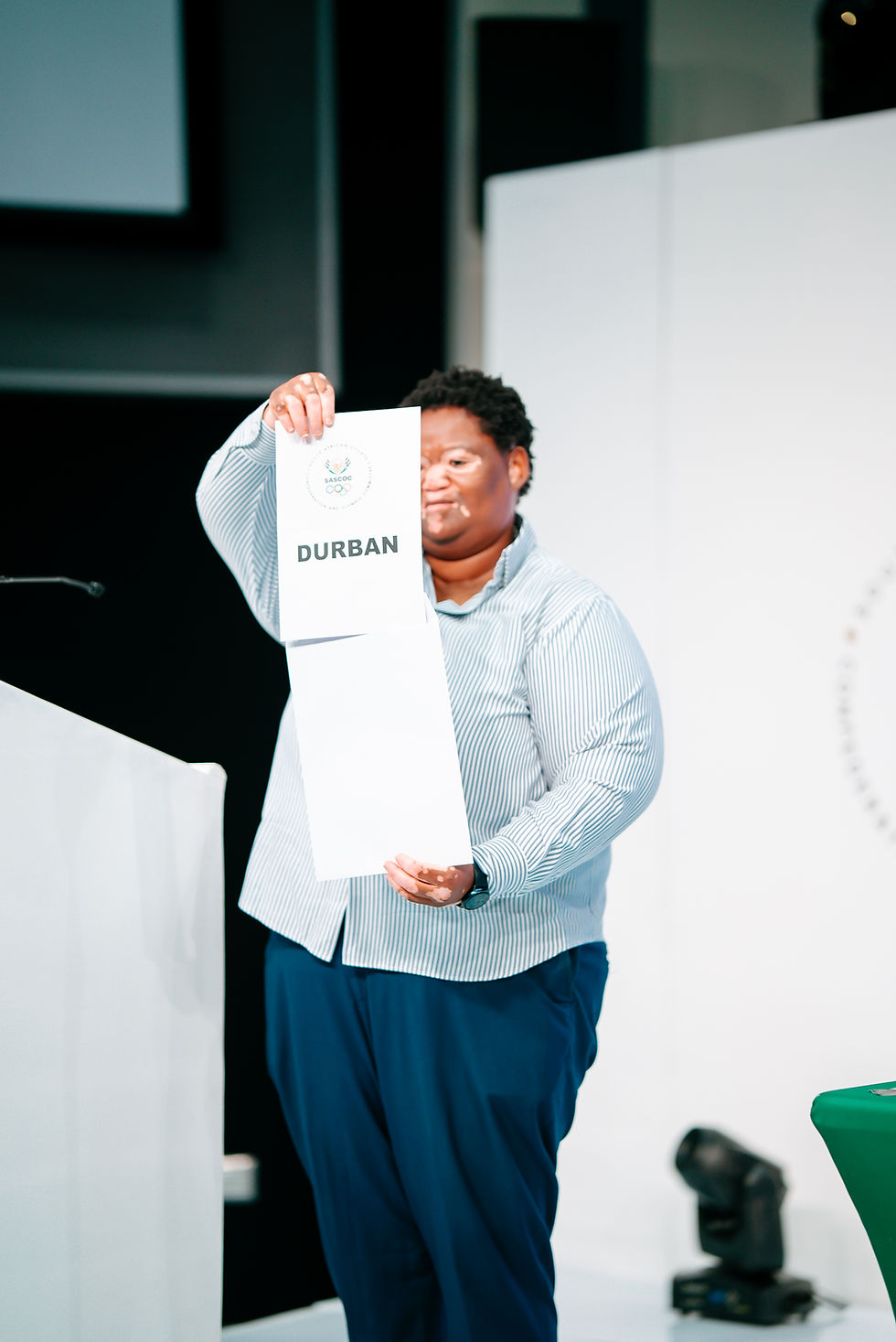
The South African Sports Confederation, Olympic and Paralympic Committee (SASCOC) announced Durban as South Africa's preferred Host City for the proposed 2036/2040 Olympic and Paralympic Games on Thursday. It is a milestone in the country's ambition to bring the world's greatest sporting celebration to African soil for the first time.
Addressing the media, SASCOC Acting President Lwandile Simelane said the ambition rests on a simple conviction: sport can cross borders, unite people and drive real social and economic progress.
"Somewhere in our country today, a child laced up a worn pair of shoes and ran. It might have been on a dusty field, a township street or a school ground by the sea. For generations, children across our continent have dreamed of the Olympic and Paralympic Games, and for generations that dream has had a faraway address. Today, we take a historic step towards bringing it home, to Africa, the birthplace of humanity."
South Africa has repeatedly shown that it can welcome the world. The 1995 Rugby World Cup became an enduring symbol of reconciliation under President Nelson Mandela. The 2010 FIFA World Cup was the first held on African soil. Many other major sporting events have followed, including, amongst many others, the ICC Women’s Cricket World Cup and the Netball World Cup - both in 2023.
Each occasion demonstrated the country's institutional capability, infrastructure and ability to mobilise national resources behind a shared goal. Simelane said the bid would build on that experience while taking full account of the scale of the task. Hosting the Games is often compared to staging dozens of World Cups at once.
"In 1995, we showed the world the power of sport to unite a nation. In 2010, we showed that Africa could deliver on the grandest stage. In 2023, we showed that we could unite behind women’s sport. In 2036, we aspire to bring the world's greatest celebration of human achievement to the continent.”
A central pillar of the candidature will be its potential to attract investment, create employment and accelerate infrastructure development. The 2010 FIFA World Cup showed what a major event can unlock.
After South Africa won the right to host the tournament in May 2004, the country enjoyed some of the strongest growth of the democratic era, particularly between 2004 and 2007. In 2010, then Finance Minister Pravin Gordhan estimated that World Cup-related stadium and infrastructure investment since 2006 had left GDP about 1% higher than it would otherwise have been. South Africa's official assessment recorded an estimated 130 000 jobs in construction, roads, transport and hospitality in the lead-up to the event and approximately 415 000 more indirectly.
The transport, airport, telecommunications and urban investments of that period continue to serve the country today.
"The greatest legacy of the 2010 World Cup was not what happened during those four weeks. It was what South Africa was able to build and unlock because we had the ambition to host it," said Simelane.
The candidature will seek to align Olympic preparations with national, provincial and metropolitan priorities, particularly public transport, housing, urban regeneration, tourism, skills development and sporting infrastructure.
SASCOC's hosting vision will follow the IOC's reformed approach, including the New Norms, which emphasise financial sustainability, flexibility, the reuse of existing infrastructure and long-term community benefit.
South Africa intends to prioritise existing venues, the refurbishment of established facilities and temporary infrastructure wherever appropriate. Any new permanent infrastructure must be justified by a credible long-term public or sporting need, not by the requirements of a single event. A regional hosting concept will seek to extend economic participation and opportunity beyond the principal Host City, and sound governance, environmental responsibility and measurable social impact will guide the candidature as it develops.
"Success will not be measured only by the facilities we build or the spectacle we present. It will be measured by what remains after the final medal has been awarded: better infrastructure, greater opportunity, stronger communities and a more united and prosperous nation."
At the heart of the proposal is a vision that reflects the spirit of South Africa, the aspirations of the continent and the universal ideals of the Olympic and Paralympic Movements. It is a bid that:
places athletes at its heart, with inclusion, accessibility and equal opportunity at its core;
celebrates the unity in diversity;
shares its benefits through a regional hosting vision; and
serves as a catalyst for shared prosperity that endures for generations.
Simelane said the Paralympic Movement would play an integral role in advancing universal accessibility and the recognition of athletes with disabilities, helping to remove the barriers that keep millions from participating fully in society.
She noted that South Africa's own history shows what sport can do. The image of President Mandela in the Springbok jersey in 1995 and the shared pride of 2010 both reminded the country that far more unites us than divides us.
"At a time when our country faces profound economic and social challenges, we have an opportunity to unite around a vision of what South Africa can become, through the determination, cooperation and investment that a shared national ambition can inspire."
SASCOC acknowledged the cities and provinces that took part in the national selection process and thanked them for their commitment.
Durban was selected following a thorough and independent evaluation process involving three interested cities, Cape Town, Durban and Johannesburg. All three cities presented strong proposals, demonstrating South Africa's existing sporting infrastructure, experience in hosting major international events and potential to deliver world-class competitions. During October 2026, an independent evaluation panel conducted city presentations and venue visits to assess each city's proposed hosting concept and facilities.
The evaluation was closely contested, with each city demonstrating its strengths and potential to contribute to South Africa's Olympic and Paralympic goals.
SASCOC CEO, Nozipho Jafta, who has spearheaded South Africa’s process of engagement with all interested parties and the IOC, added that “As South Africa’s National Olympic and Paralympic Committee, SASCOC has been engaging with the IOC through its Future Host Selection Process. We have followed the IOC’s guidelines and timelines in advancing our engagement through Continuous Dialogue. Continuous Dialogue allows interested parties and the IOC to examine the vision and feasibility of hosting. It is the stage at which important questions about venues, athlete experience, funding and long-term legacy begin to take shape. The IOC’s process provides the structure for turning an aspiration into a proposal that can be properly assessed.
“Here at home, we have worked to ensure that our engagement with the IOC is supported by a considered national process. In May, provinces and cities were briefed on the IOC’s Future Host Selection Process, and a call was made for cities interested in hosting to submit their expressions of interest.”
The designation of Durban marks the start of a coordinated national effort to develop a credible and competitive hosting proposition.
South Africa is taking part in the IOC's Continuous Dialogue process and will present its hosting vision to the IOC Future Host Commission in November 2026. Under the IOC's revised timetable, interested parties are expected to be considered for progression to Strategic Dialogue in March 2027, with the election of the 2036 host scheduled for mid-2029. The path ahead will demand rigorous technical preparation, financial assessment, institutional cooperation and public support.
"We approach the road ahead with humility, with determination and with the confidence that South Africa has both the experience and the ambition to make a meaningful contribution to the future of the Olympic Movement."
Simelane closed by returning to the young athletes at the centre of the ambition.
"This dream is not only about the honour of hosting the world. It is about the chance to transform our country, inspire our continent and leave a legacy worthy of the generations yet to come."


Comments